
Persistent bad breath
Why bad breath keeps coming back when you brush and floss
Because the smell is not on your teeth. It is a by-product of specific bacteria digesting protein at the back of your tongue and below your gumline — and those bacteria can be measured.
What the test measures here
The test does not measure odor itself. It measures the oral microbial community that can contribute to the conditions in which persistent odor develops.
Where the smell actually comes from
Odor is a by-product of bacteria digesting protein
The smell most people mean by bad breath comes from a small family of gases called volatile sulfur compounds — mainly hydrogen sulfide and methyl mercaptan. They are what your nose is detecting.
Those gases are produced when certain bacteria that thrive without oxygen break down proteins — from food debris, from saliva, and from the normal turnover of cells in your mouth. The bacteria are not doing anything unusual. They are feeding, and the gas is what is left over.
Persistent odor is mostly oral in origin, and it concentrates in two places: the back of the tongue, where the surface is rough enough to hold a thick coating, and the pockets around the gumline. Both are low in oxygen, both are protein-rich, and both are difficult to reach.
Why the usual fixes fade
Rinses and mints work on the gas. The community makes more.
Mints and most rinses act on the output — they mask the smell, or they neutralize the compounds already in your mouth. Antibacterial rinses go further and reduce the bacterial load directly. Tongue scraping physically removes some of the coating that holds it.
All three act on a community that regrows. Bacteria on the tongue re-establish over hours, which is why the effect tends to be measured in hours too.
Reducing odor and knowing which organisms are present are two different things. Doing the first tells you nothing about the second.
All sixteen on the panel
Which organisms are actually associated with odor
The Balance Test measures sixteen organisms. Four are strongly associated with odor, five are mixed or unclear, five are associated with a healthier mouth, and two have nothing to do with breath at all.
P. gingivalisPorphyromonas gingivalis What it is & how it relates to odor ›
What it isA periodontal organism often described in the literature as a keystone species in gum disease.
Relationship to odorBreaks down proteins and releases methyl mercaptan, one of the two compounds most closely associated with persistent mouth odor. Repeatedly associated with halitosis in published research.
T. denticolaTreponema denticola What it is & how it relates to odor ›
What it isA spiral-shaped organism found in gum pockets; one of three commonly grouped together as the red complex.
Relationship to odorReported to produce both methyl mercaptan and hydrogen sulfide.
T. forsythiaTannerella forsythia What it is & how it relates to odor ›
What it isThe third member of the red complex, associated with periodontal disease.
Relationship to odorAssociated with halitosis and with tongue coating in clinical studies.
F. nucleatum (animalis)Fusobacterium nucleatum subsp. animalis What it is & how it relates to odor ›
What it isA bridging organism — it binds early and late colonizers together into the structured communities that form on teeth and tongue.
Relationship to odorF. nucleatum is among the most prolific sulfur-compound producers studied.
Most of that research examines F. nucleatum at species level rather than the animalis subspecies measured here, so the association is reported at species level.
Veillonella narGVeillonella spp. What it is & how it relates to odor ›
What it isA nitrate-reducing group. The Balance Test reports it as a narG gene detection — the nitrate-reductase gene attributed to Veillonella — rather than as a count of the organism itself.
Relationship to odorVeillonella has been reported to produce hydrogen sulfide. The same group also sits on the protective side of the report, for its part in the nitrate pathway.
Both are true at once, which is why a single organism name is a poor guide on its own.
F. alocisFilifactor alocis What it is & how it relates to odor ›
What it isStrongly associated with periodontitis, and increasingly studied as a marker of it.
Relationship to odorDirect evidence tying it to odor is limited.
A. actinomycetemcomitansAggregatibacter actinomycetemcomitans What it is & how it relates to odor ›
What it isA periodontal organism associated with more aggressive presentations of gum disease.
Relationship to odorNot a notable odor producer. It is on the panel for gum-health reasons rather than breath ones.
Actinomyces narGActinomyces spp. What it is & how it relates to odor ›
What it isReported as a narG gene detection — the nitrate-reductase gene attributed to Actinomyces.
Relationship to odorCommonly present in tongue coating, but its role in odor is unclear.
CandidaCandida spp. What it is & how it relates to odor ›
What it isA yeast rather than a bacterium, included because it is part of the community the panel describes.
Relationship to odorNot a primary odor organism, and the evidence linking it to breath odor is limited.
S. salivariusStreptococcus salivarius What it is & how it relates to odor ›
What it isOne of the most common commensal organisms on the tongue.
Relationship to odorObserved more often on the tongues of people without halitosis in comparative studies.
Rothia narGRothia spp. What it is & how it relates to odor ›
What it isReported as a narG gene detection — the nitrate-reductase gene attributed to Rothia, one of the strongest nitrate reducers in the mouth.
Relationship to odorCommonly abundant in mouths without persistent odor. It is measured here for the nitrate pathway rather than for breath.
Neisseria narGNeisseria spp. What it is & how it relates to odor ›
What it isReported as a narG gene detection — the nitrate-reductase gene attributed to Neisseria.
Relationship to odorCommonly abundant in mouths without persistent odor, and part of the same nitrate pathway.
S. sanguinisStreptococcus sanguinis What it is & how it relates to odor ›
What it isAn early colonizer of tooth surfaces.
Relationship to odorAssociated with periodontal health rather than with odor.
S. mitisStreptococcus mitis What it is & how it relates to odor ›
What it isAn early colonizer, common in balanced oral communities.
Relationship to odorAssociated with periodontal health rather than with odor.
S. mutansStreptococcus mutans What it is & how it relates to odor ›
What it isThe organism most associated with tooth decay.
Relationship to odorNot an odor organism. Measured for cavity risk.
S. sobrinusStreptococcus sobrinus What it is & how it relates to odor ›
What it isWorks alongside S. mutans in the decay process.
Relationship to odorNot an odor organism. Measured for cavity risk.
No organisms in that group.
Saliva carries bacteria shed from the tongue and from gum pockets, so it reflects where odor is produced without being a direct swab of those sites. Detection Levels are not shown here; those belong with a real result.
What a saliva test can add
- Measures
- The periodontal-associated organisms, protective commensals and nitrate-reducing capacity that make up the oral community. There is no odor reading.
- Shows
- A mouth-wide microbial pattern from one saliva sample, which is a different view from the site-by-site measurements of a dental exam.
- Tracks
- A consistent baseline you can compare with a later sample.
It is not a list of bad guys
The same saliva holds the other side of the argument
Five of the sixteen organisms on this map are associated with a healthier mouth, not a worse one. They compete for the same surfaces and the same protein, and several are part of the nitrate pathway the report scores separately.
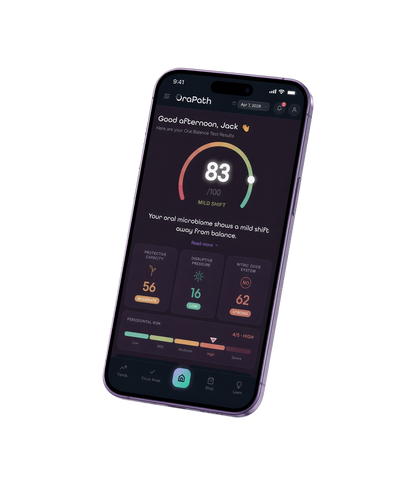
So the reading is not a tally of organisms. What matters is which side of that community is doing better — the report calls these protective capacity and disruptive pressure, and reports them as two separate figures rather than netting them into one.
Two people can carry the same odor-associated organism and have very different results, because what surrounds it differs.
What a saliva test can and cannot tell you
It measures bacteria, not breath
What it can show. Which of the sixteen organisms are present in your sample, and at what detection level. That includes the ones associated with odor and the ones associated with a healthier community.
What it cannot do. It cannot smell anything. There is no odor measurement in the result, and no score for how your breath smells to anyone else. It cannot rule out causes outside the mouth. It describes a pooled saliva sample, so it cannot point to a particular tooth or a particular part of the tongue. And it is not a diagnosis — that is something only a dentist can arrive at, with an examination.
What it reports is which organisms are there, at what level, for someone who can act on it.
When it is not your mouth
Some persistent odor starts elsewhere
Most persistent bad breath is oral in origin, but not all of it. Odor can also come from the tonsils, particularly where tonsil stones form; from the sinuses and post-nasal drainage; from the digestive system, including reflux; from dry mouth, which several common medications can contribute to; and from a number of medical conditions.
None of that is a suggestion that any of these applies to you. If oral causes have been looked at and addressed and the odor persists, that is worth raising with a physician rather than working through more oral products.
Common questions
What causes persistent bad breath?
Persistent odor is most often produced in the mouth, when bacteria that thrive without oxygen break down proteins and release volatile sulfur compounds — chiefly hydrogen sulfide and methyl mercaptan. The back of the tongue and the pockets around the gumline are where that happens most. Some persistent odor has causes outside the mouth, which a physician is the right person to look at.
Why does my breath come back even though I brush and floss?
Brushing and flossing act on surfaces that a brush and floss can reach. Much of the odor-associated community sits in the coating on the back of the tongue and below the gumline, which are harder to disturb. The community also re-establishes within hours, so anything that reduces it temporarily tends to have a temporary effect.
Does mouthwash stop working over time?
Rinses reduce bacteria or neutralize odor compounds for a period, and then the community regrows. That is what they are designed to do and it is not a defect. It is a different thing from knowing which organisms are present, which is what a saliva panel reports.
Can a saliva test tell me why my breath smells?
It can tell you which odor-associated organisms are present in your sample and at what level, alongside the organisms associated with a healthier community. It cannot smell anything, it does not score your breath, and it is not a diagnosis. Results are meant to be read by a dentist alongside an examination.
Which bacteria are associated with bad breath?
The organisms most consistently associated with odor in published research are Porphyromonas gingivalis, Treponema denticola, Tannerella forsythia and Fusobacterium nucleatum, which produce sulfur compounds as they break down protein. The map above shows where each of the sixteen organisms on the Balance Test sits, including the ones with little or no odor association.
OraPath Oral Balance Test
See what your oral microbiome looks like.
Collect a simple saliva sample at home. OraPath processes it in our CLIA-certified, COLA-accredited laboratory and returns a plain-language report you can review yourself and share with your dentist.
- At-home saliva collection
- 16 targeted organisms and functions
- Processed within 2 business days of reaching our lab
- Private digital report
$149.00, regular price $199.00
One-time purchase · no subscription · free shipping both ways
Also from OraPath
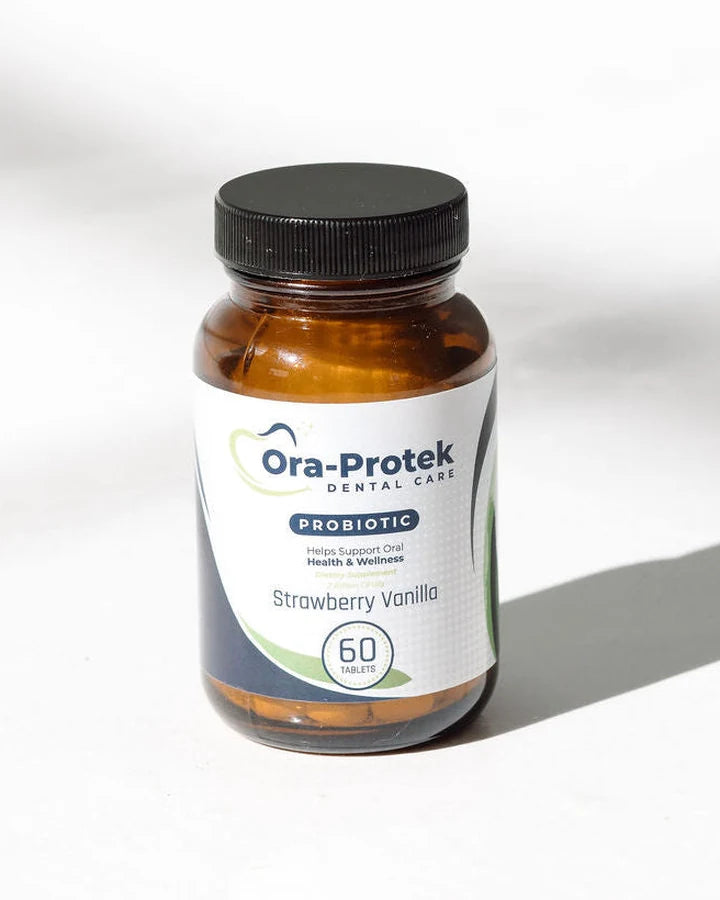
Ora-Protek, our oral probiotic
Ora-Protek is a dissolvable tablet. An oral probiotic is meant for the mouth rather than the gut, so it is dissolved rather than swallowed.
It carries sixteen probiotic species and comes in a natural strawberry-vanilla flavor. A bottle holds sixty. Per the label, adults and children twelve and over take two daily; children four and up take one.
References
- Tonzetich J. Production and origin of oral malodor: a review of mechanisms and methods of analysis. J Periodontol. 1977;48(1):13–20.
- Yaegaki K, Sanada K. Volatile sulfur compounds in mouth air from clinically healthy subjects and patients with periodontal disease. J Periodontal Res. 1992;27(4 Pt 1):233–238.
- Scully C, Greenman J. Halitosis (breath odor). Periodontol 2000. 2008;48:66–75.
- Seerangaiyan K, van Winkelhoff AJ, Harmsen HJM, Rossen JWA. The tongue microbiome in healthy subjects and patients with intra-oral halitosis. J Breath Res. 2017;11(3):036010.
- Ademovski SE, Persson GR, Winkel E, Tangerman A. The short-term treatment effects on the microbiota at the dorsum of the tongue in intra-oral halitosis patients — a randomized clinical trial. Clin Oral Investig. 2013;17(2):463–473.
These sources cover where breath odor is produced, which compounds carry it, the sites it comes from, and how long an intervention on the tongue lasts. The evidence labels on the organism map above describe each organism's relationship to odor and are drawn from the general literature rather than from these five.
This page describes associations reported in published research. It does not describe what any result means for an individual. The Oral Balance Test is a laboratory-developed test performed by IMMYLabs (CLIA #37D2236199; COLA #32679), validated under CLIA, 42 U.S.C. § 263a. It has not been cleared or approved by the U.S. Food and Drug Administration. Results are for adjunctive use and support a dentist's examination rather than replacing one.
Laboratory developed test · for adjunctive clinical use · not FDA cleared.
Not in your state yet
We can't ship the test to you yet. We'll tell you the day that changes.
Lab licensing works state by state, and a few are still in progress. If you're in one of them, leave your email and we'll let you know the moment the Oral Balance Test is available where you live — nothing else.
- Alaska
- California
- Connecticut
- Hawaii
- Maryland
- Massachusetts
- New Jersey
- New York
- Rhode Island