
Oral probiotics
Do oral probiotics actually do anything?
The mouth has its own microbial community, and a capsule you swallow never reaches it. That distinction is the whole idea behind an oral probiotic — and it is worth understanding before you buy one, from us or from anyone.
The mouth is not the gut
A capsule you swallow never gets here
Most probiotics are built for the intestine. They are made to survive the stomach, and they do their work somewhere a lozenge never reaches.
The mouth is a different environment with a different resident community. It is aerobic where the gut is not, it is washed constantly by saliva, and it holds hard surfaces — teeth — that nothing else in the body has. The organisms that live well there are not the same ones that live well in an intestine.
That is the whole argument for the format. A tablet that dissolves in your mouth puts its contents on the tongue, the teeth and the gumline. A capsule you swallow does not.
What a probiotic is doing there
Competition for space, mostly
The honest version of this category is simpler than the marketing suggests. Beneficial species and disruptive ones want the same surfaces and the same nutrients. When the beneficial side is well established, there is less room for anything else to settle.
Some species also produce compounds that inhibit their neighbors. That is what the “BLIS” in BLIS K12 stands for — bacteriocin-like inhibitory substances. K12 is characterized by two of them, salivaricin A2 and salivaricin B. M18 produces bacteriocins of its own, along with the enzymes dextranase and urease.
That is the mechanism, and it is where the confident part of this page ends. Ora-Protek supports a balanced oral microbiome. It is not a treatment for anything, and this page is not going to tell you otherwise.
Everything in the blend
The sixteen, and what is actually known about each
Ora-Protek carries sixteen probiotic species. Two are named strains with published work of their own. The other fourteen appear on the label by species only, and where there is no strain designation there is nothing strain-specific to claim — so we do not claim any.
S. salivarius BLIS K12™Streptococcus salivarius K12Evidence: limited
Streptococcus salivarius is one of the most common bacteria of the healthy mouth, and is an early colonizer of the tongue. K12 is a named strain of it, licensed from BLIS Technologies.
Characterized by the lantibiotics salivaricin A2 and salivaricin B. Its published oral-care work is thinner than M18's: the closest trial gave it to children after chlorhexidine and tongue scraping, so what it did on its own cannot be separated out. The rest of the K12 literature looks at the throat and ears, which is not what this page is about.
S. salivarius BLIS M18™Streptococcus salivarius M18Evidence: moderate
The same species as K12 but a different named strain, also licensed from BLIS Technologies. Probiotic evidence is strain-specific, so the two are not interchangeable and nothing shown for one carries over to the other.
The more studied of the two in a dental context. Produces bacteriocins targeting Streptococcus mutans, plus the enzymes dextranase and urease. Two placebo-controlled trials are summarized below.
L. paracaseiLacticaseibacillus paracaseiIncluded in the blend
Part of the proprietary probiotic blend. The panel lists it by species; no strain designation is given, so nothing strain-specific is claimed for it here.
L. casei subsp. caseiLacticaseibacillus casei subsp. caseiIncluded in the blend
Part of the proprietary probiotic blend. The panel lists it by species; no strain designation is given, so nothing strain-specific is claimed for it here.
L. rhamnosusLacticaseibacillus rhamnosusIncluded in the blend
Part of the proprietary probiotic blend. The panel lists it by species; no strain designation is given, so nothing strain-specific is claimed for it here.
L. plantarumLactiplantibacillus plantarumIncluded in the blend
Part of the proprietary probiotic blend. The panel lists it by species; no strain designation is given, so nothing strain-specific is claimed for it here.
L. fermentumLimosilactobacillus fermentumIncluded in the blend
Part of the proprietary probiotic blend. The panel lists it by species; no strain designation is given, so nothing strain-specific is claimed for it here.
B. breveBifidobacterium breveIncluded in the blend
Part of the proprietary probiotic blend. The panel lists it by species; no strain designation is given, so nothing strain-specific is claimed for it here.
L. brevisLevilactobacillus brevisIncluded in the blend
Part of the proprietary probiotic blend. The panel lists it by species; no strain designation is given, so nothing strain-specific is claimed for it here.
L. sakeiLatilactobacillus sakeiIncluded in the blend
Part of the proprietary probiotic blend. The panel lists it by species; no strain designation is given, so nothing strain-specific is claimed for it here.
L. reuteriLimosilactobacillus reuteriIncluded in the blend
Part of the proprietary probiotic blend. The panel lists it by species; no strain designation is given, so nothing strain-specific is claimed for it here.
S. thermophilusStreptococcus thermophilusIncluded in the blend
Part of the proprietary probiotic blend. The panel lists it by species; no strain designation is given, so nothing strain-specific is claimed for it here.
B. lactisBifidobacterium lactisIncluded in the blend
Part of the proprietary probiotic blend. The panel lists it by species; no strain designation is given, so nothing strain-specific is claimed for it here.
L. lactis subsp. lactisLactococcus lactis subsp. lactisIncluded in the blend
Part of the proprietary probiotic blend. The panel lists it by species; no strain designation is given, so nothing strain-specific is claimed for it here.
B. bifidumBifidobacterium bifidumIncluded in the blend
Part of the proprietary probiotic blend. The panel lists it by species; no strain designation is given, so nothing strain-specific is claimed for it here.
B. longumBifidobacterium longumIncluded in the blend
Part of the proprietary probiotic blend. The panel lists it by species; no strain designation is given, so nothing strain-specific is claimed for it here.
Read from the printed supplement facts panel. The blend is declared by weight — 120 mg in total — rather than by CFU count, and the label gives no per-species amounts, so none are shown here.
The studies behind the two named strains
These describe what researchers measured. They are not statements about what Ora-Protek will do for you, and none of them was run on this product.
-
S. salivarius M18
In a randomized, double-blind, placebo-controlled trial, 100 caries-active children took M18 for three months and were assessed for changes in dental plaque. The paper also describes the strain's bacteriocins against Streptococcus mutans and its dextranase and urease activity.
Children, three months. Several authors were employed by BLIS Technologies, which supplies the strain — worth knowing when reading it.
Burton JP, Drummond BK, Chilcott CN, et al. Influence of the probiotic Streptococcus salivarius strain M18 on indices of dental health in children: a randomized double-blind, placebo-controlled trial. J Med Microbiol. 2013;62(Pt 6):875–884. · doi:10.1099/jmm.0.056663-0
-
S. salivarius M18
Sixty-two adults with gingivitis took M18 lozenges or placebo for three months in a double-blind trial. Gingival and bleeding indices were measured at one, two and three months, with plaque as a secondary measure, followed by a one-month washout.
Adults, three months, lozenge format — the closest published design to how Ora-Protek is taken. The dose used is not something we can match to our label, which declares the blend by weight rather than by count.
Babina K, Salikhova D, Makeeva I, et al. A three-month probiotic (the Streptococcus salivarius M18 strain) supplementation decreases gingival bleeding and plaque accumulation: a randomized clinical trial. Dent J (Basel). 2024;12(7):222. · doi:10.3390/dj12070222
-
S. salivarius K12
A randomized controlled trial of 208 children with measurable oral malodor compared four regimens. The group that improved most had conventional hygiene plus tongue scraping plus chlorhexidine plus the probiotic.
Children, and — the reason this is filed under limited — there was no arm testing K12 on its own. The probiotic sat on top of chlorhexidine and tongue scraping, so its individual contribution was not isolated.
Jamali Z, Aminabadi NA, Samiei M, et al. Impact of chlorhexidine pretreatment followed by probiotic Streptococcus salivarius strain K12 on halitosis in children: a randomised controlled clinical trial. Oral Health Prev Dent. 2016;14(4):305–313. · doi:10.3290/j.ohpd.a36521
-
S. salivarius K12
A review summarizing the characterization of K12, including the salivaricin A2 and salivaricin B it produces, and its reported persistence in the mouth for about a month after dosing stops.
The clinical outcomes in this review concern the throat, not the mouth. It is cited here only for the characterization and persistence material.
Di Pierro F, Colombo M, Zanvit A, Rottoli AS. Positive clinical outcomes derived from using Streptococcus salivarius K12 to prevent streptococcal pharyngotonsillitis in children. Drug Healthc Patient Saf. 2016;8:77–81. · doi:10.2147/DHPS.S117214
It does not stay
This is why it is a daily habit, not a course
Bacteria delivered to the mouth generally do not take up permanent residence. Saliva clears, you eat, you brush, and the community returns toward whatever it was.
There is a figure attached to that for K12: after the last dose it has been reported as detectable in the mouth for around a month, then not. In the three-month M18 trial described below, the authors made the same point in their own words — they did not expect a lasting effect without continued intake.
So a lozenge is not something you finish. It is taken daily, the way you would take anything whose effect depends on being there. We would rather say that plainly than imply permanence.
How to take it
Dissolved, not swallowed
Per the label: adults and children twelve and over take two tablets daily. Children aged four and up take one tablet daily.
The tablet is meant to dissolve in the mouth rather than be chewed or swallowed — the point is contact time with the tongue, teeth and gumline. Taking it after brushing, last thing, means nothing washes it straight back out.
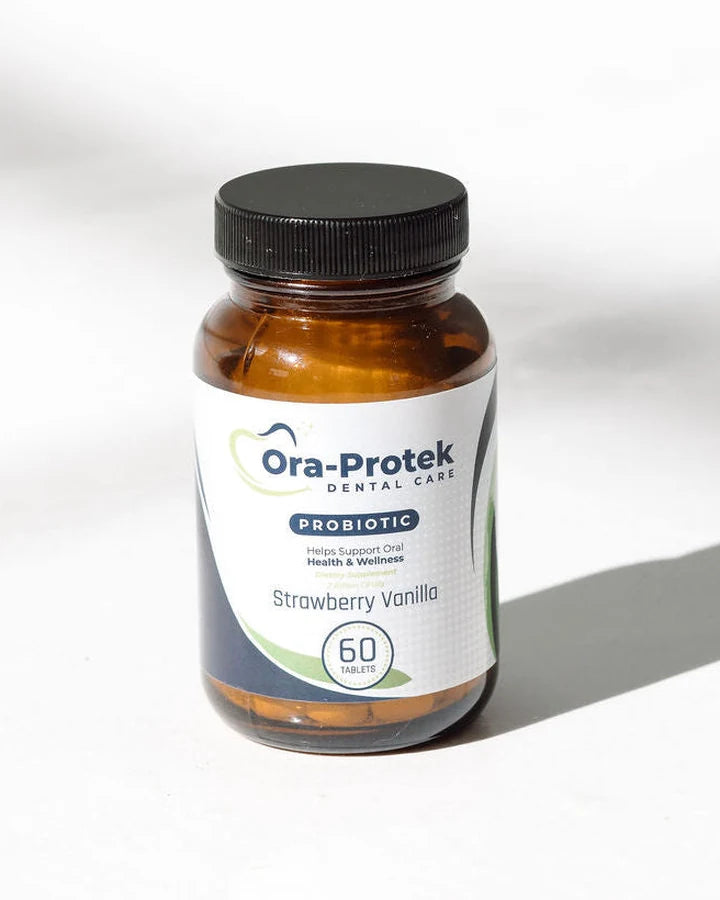
It is a strawberry-vanilla tablet, sixty to a bottle. Keep out of reach of children. Consult your physician before use if you are pregnant, nursing, taking medication or have a medical condition.
Common questions
Do oral probiotics actually work?
The mechanism is well described: beneficial species compete with disruptive ones for the same surfaces and nutrients, and some produce compounds that inhibit their neighbors. How much any particular product does depends on the specific strains in it, which is why strain designations matter more than species names.
How is this different from a gut probiotic?
Where it goes. A capsule you swallow is built to survive the stomach and act in the intestine. A tablet that dissolves in the mouth puts its contents on the tongue, teeth and gumline instead. The mouth has its own resident community, and it is not the same one.
Is this the same as using a mouthwash?
They do different things. An antibacterial rinse reduces bacteria broadly and temporarily. A probiotic adds beneficial species. Neither is a substitute for the other, and this page is not claiming one works better than the other.
What are BLIS K12 and BLIS M18?
Two named strains of Streptococcus salivarius, a common bacterium of the healthy mouth. They are licensed from BLIS Technologies. “BLIS” refers to bacteriocin-like inhibitory substances, the compounds those strains are characterized by producing.
Do I need to keep taking it?
Bacteria delivered to the mouth generally do not colonize permanently, so it is taken daily rather than as a course. Anything in this category promising a permanent change from one course is worth questioning.
See the product
Format, full ingredient list, flavor and price — all on the product page.
See Ora-ProtekThese statements have not been evaluated by the Food and Drug Administration. This product is not intended to diagnose, treat, cure, or prevent any disease.