
Not all mouthwash does the same thing.
Most of the "rinsing wrecks your microbiome" advice online rests on studies of chlorhexidine — a prescription antiseptic meant for short-term use under supervision. Your daily rinse probably isn't that. Instead of guessing which camp yours falls into, measure what's actually in your mouth.
$149$199
one-time · ships free · launch price through October 31
Not yet available in AK, CA, CT, HI, MD, MA, NJ, NY, RI. Get notified when we reach your state
"Mouthwash" is at least three different products.
They get discussed as one thing, which is how a finding about a prescription antiseptic turns into a blanket warning about the bottle in your bathroom. The three below work by different mechanisms at different strengths. Knowing which one you use matters more than any general rule about rinsing.
Prescription antiseptics
Chlorhexidine and similar medicated rinses. Potent, they cling to oral surfaces for hours, and they're prescribed deliberately — after surgery, or during active periodontal treatment. Most of the alarming research on rinses and nitric oxide was done with these. If your dentist prescribed one, that is a clinical decision and this page is not a reason to stop.
Everyday antiseptic rinses
The essential-oil and CPC rinses on a supermarket shelf. A different class from chlorhexidine — different active ingredients, different potency, and they don't linger the same way. Treating the two as interchangeable is the shortcut that makes most of this advice unreliable.
Fluoride and cosmetic rinses
A fluoride rinse isn't an antiseptic at all — it's there to protect enamel. A cosmetic rinse mostly addresses breath. Neither belongs in a conversation about wiping out bacteria, and folding them in is simply wrong.
This is the pathway the argument is about.
Certain bacteria in your mouth do something most people never learn about: they help turn the nitrate in leafy greens and beets into nitric oxide, a molecule your body uses for healthy blood flow and circulation. The conversion starts in the mouth. Without the right bacteria, the pathway stalls before your body can finish it.
-
Dietary nitrate
Leafy greens, beets and similar foods are eaten.
-
Concentrated in saliva
Nitrate is absorbed and concentrated back into saliva.
-
Oral conversion
Your bacteria convert nitrate to nitrite. This is the step that depends on which organisms you have — and the one we measure.
The step we measure -
Becomes nitric oxide
Nitrite is swallowed and converted further into nitric oxide.
-
Blood flow
Nitric oxide is associated in research with healthy blood flow.
What most products assume
That the oral step is working
Nitrate supplements, beet powders, and NO boosters all depend on this conversion happening in your mouth. None of them check whether it does. If your oral bacteria can't perform the step, more nitrate doesn't help.
What we measure
The gene that does the work
We don't just check whether nitrate-reducing species are present — we target the narG gene that performs the conversion. Detecting that gene tells us the capability is actually there, not just that a related organism happens to be present. That's why we can describe this as functional capacity rather than a simple count.
The systemic links here are associations reported in research, not conclusions about any individual. What your score reflects is the oral step of the pathway. The Oral Balance Test measures your oral microbiome; it does not diagnose gum disease, cavities, or any medical condition.
One sample. Four steps.
No appointment, no fasting, no prep.
Order your kit
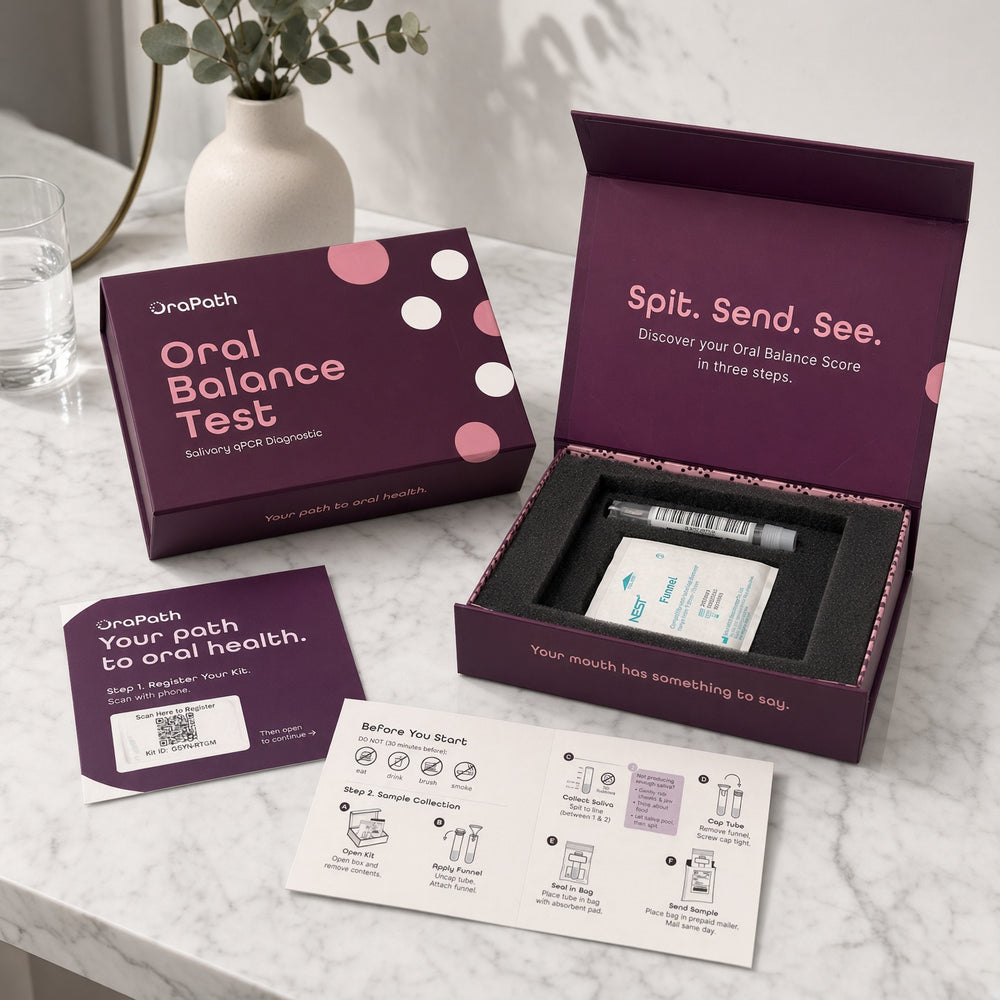
Buy online and we ship a complete saliva collection kit to your door — free.
Collect at home
Let saliva pool and spit into the tube until it reaches the line. About two minutes, no appointment, no swab and no blood.
Mail it back
Seal it in the prepaid return envelope and drop it in the mail. It goes straight to our CLIA-certified lab in Norman, Oklahoma.
Read your results
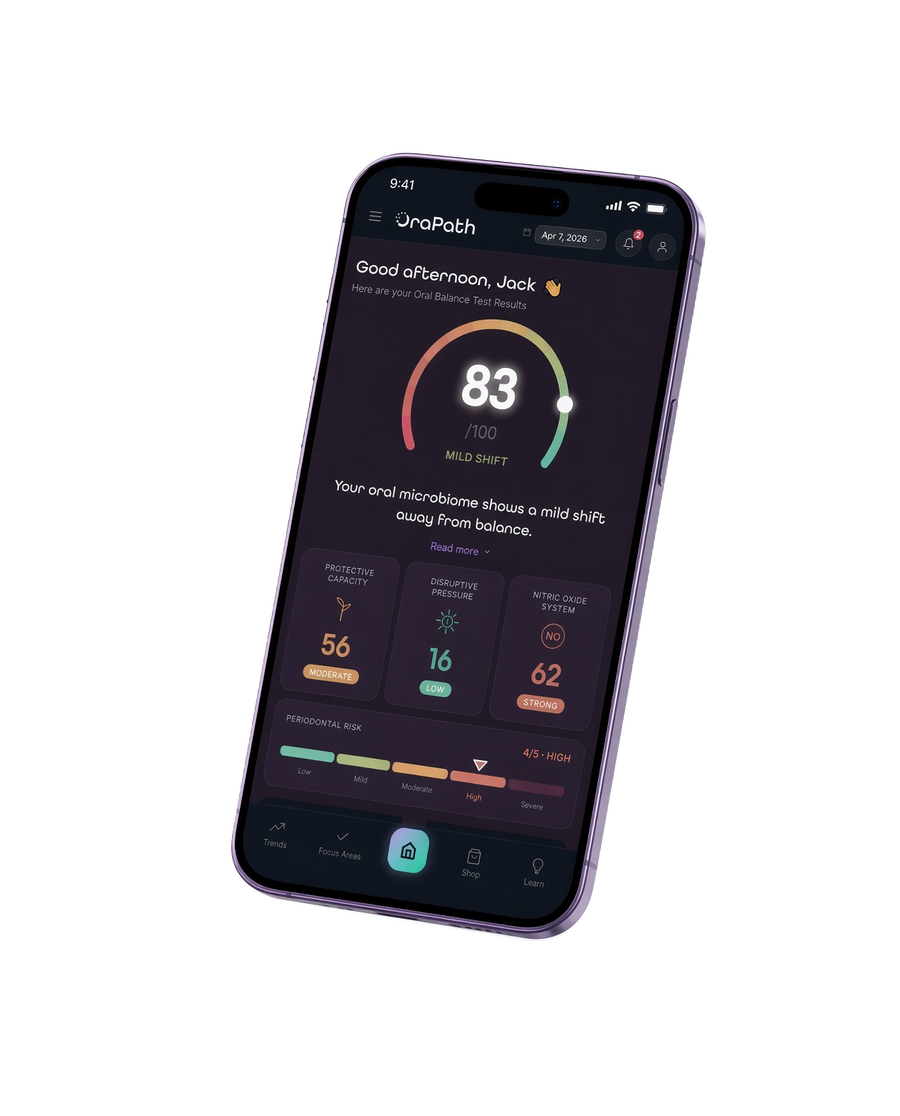
About a week from the day you mail it. Every organism listed in plain language, in your private OraPath account.
Your own numbers, instead of someone else's rule.
You can read the entire five-page sample report before you order — every page, walked through, so you know exactly what turns up.
- Your nitrate-reducing group Rothia, Neisseria, Veillonella and Actinomyces — measured individually, so you see the group this whole argument is about.
- Your protective bacteria The commensal species that compete with disease-causing organisms, and how strong that defense currently looks.
- What's pushing the other way The organisms associated with gum disease, decay and fungal overgrowth, each with its own level.
- A baseline to change something against One test is a snapshot. Two, either side of a change, is the only way to tell whether the change did anything.
Straight answers
So should I stop using my mouthwash?
We're not going to tell you that from a landing page, and you should be skeptical of anyone who does without knowing what you use or why.
One thing we'll say plainly: if a dentist prescribed a medicated rinse — chlorhexidine after a procedure, or during active periodontal treatment — keep using it as directed. That was a clinical decision made about your mouth, and stopping it because of something you read online is a worse idea than any rinse. Raise it at your next appointment instead.
Is my supermarket rinse as strong as chlorhexidine?
No — they're different products. Chlorhexidine is a prescription antiseptic that binds to the surfaces of your mouth and keeps working for hours, which is exactly why it's reserved for specific clinical situations and short courses. Everyday essential-oil and CPC rinses use different actives at different strengths and don't persist the same way. That difference is real, and flattening it is how a specific finding becomes a slogan.
What about my fluoride rinse?
Different job entirely. Fluoride rinses are there to strengthen enamel and reduce decay — they aren't antiseptics and they aren't what any of this is about. If you're using one on a dentist's advice, this page has nothing to say about it.
Will the test tell me what my mouthwash did to me?
Not from one test, and we'd rather be straight about that than imply otherwise. A single result is a snapshot of your mouth today — it can't separate the effect of your rinse from your diet, your genetics, or anything else. If attribution is what you're after, the honest method is to test, change one thing, and retest 60 to 90 days later. Each Detection Level step is roughly twice as much bacteria, so a real shift is legible rather than a judgement call.
Is this a diagnosis?
No. The Balance Test measures bacteria in your saliva. It doesn't diagnose gum disease, cavities, or any medical condition, and it isn't a substitute for a dental exam. Systemic connections described in the report are associations reported in research, not conclusions about you. Bring the report to your dentist and go through it together.
How long until I get results?
Your report is ready within 2 business days of your sample reaching our lab — about a week from the day you mail it, once transit both ways is counted. It's the same validated test dental practices order, run in our own CLIA-certified, COLA-accredited lab. It has not been cleared or approved by the FDA.
Which states do you ship to?
We ship the at-home Balance Test to most US states, but not yet to AK, CA, CT, HI, MD, MA, NJ, NY, RI. Those states apply extra requirements to at-home lab testing, and we've held them back from this first launch rather than cut corners. We're working through them.
If you're in one of those states and want the test, ask your dental practice — they can order OraPath panels for you directly.
Not in your state yet
We can't ship the test to you yet. We'll tell you the day that changes.
Lab licensing works state by state, and a few are still in progress. If you're in one of them, leave your email and we'll let you know the moment the Oral Balance Test is available where you live — nothing else.
- Alaska
- California
- Connecticut
- Hawaii
- Maryland
- Massachusetts
- New Jersey
- New York
- Rhode Island

Also from OraPath
Ora-Protek daily oral probiotic
A daily dissolvable lozenge with 16 clinically studied strains, including BLIS K12 and M18. It adds beneficial bacteria rather than removing them — a different approach from rinsing. These statements have not been evaluated by the U.S. Food & Drug Administration. This product is not intended to diagnose, treat, cure, or prevent any disease. Multi-bottle pricing from $22.00 per bottle.
Skip the debate. Measure your own mouth.
One saliva sample, collected at home in about two minutes, tells you where your nitrate-reducing bacteria and your protective species actually stand — and gives you a baseline to change something against.
Results in your private OraPath account · not a diagnosis — it measures your oral microbiome and is meant to be reviewed with a dentist alongside an exam.
Before you go
The sample report is open to read.
All five pages — every organism named, the four scores and what moved them, and every systemic association labeled by how strong the evidence actually is. No email needed to read it.
An occasional note about the test and what we're learning from it. Unsubscribe any time.
Thanks
You're on the list.
We'll be in touch now and then. In the meantime, the sample report is open whenever you want it.