
See a real result before you buy.
This is one complete Oral Balance result — every screen of the app and the five-page report it produces, from the same sample. The person is fictitious; the layout and the logic are exactly what you receive. This one came back with findings in it.
The sample opens in a new tab. Nothing on this page is a real patient's result.
What your result shows
-
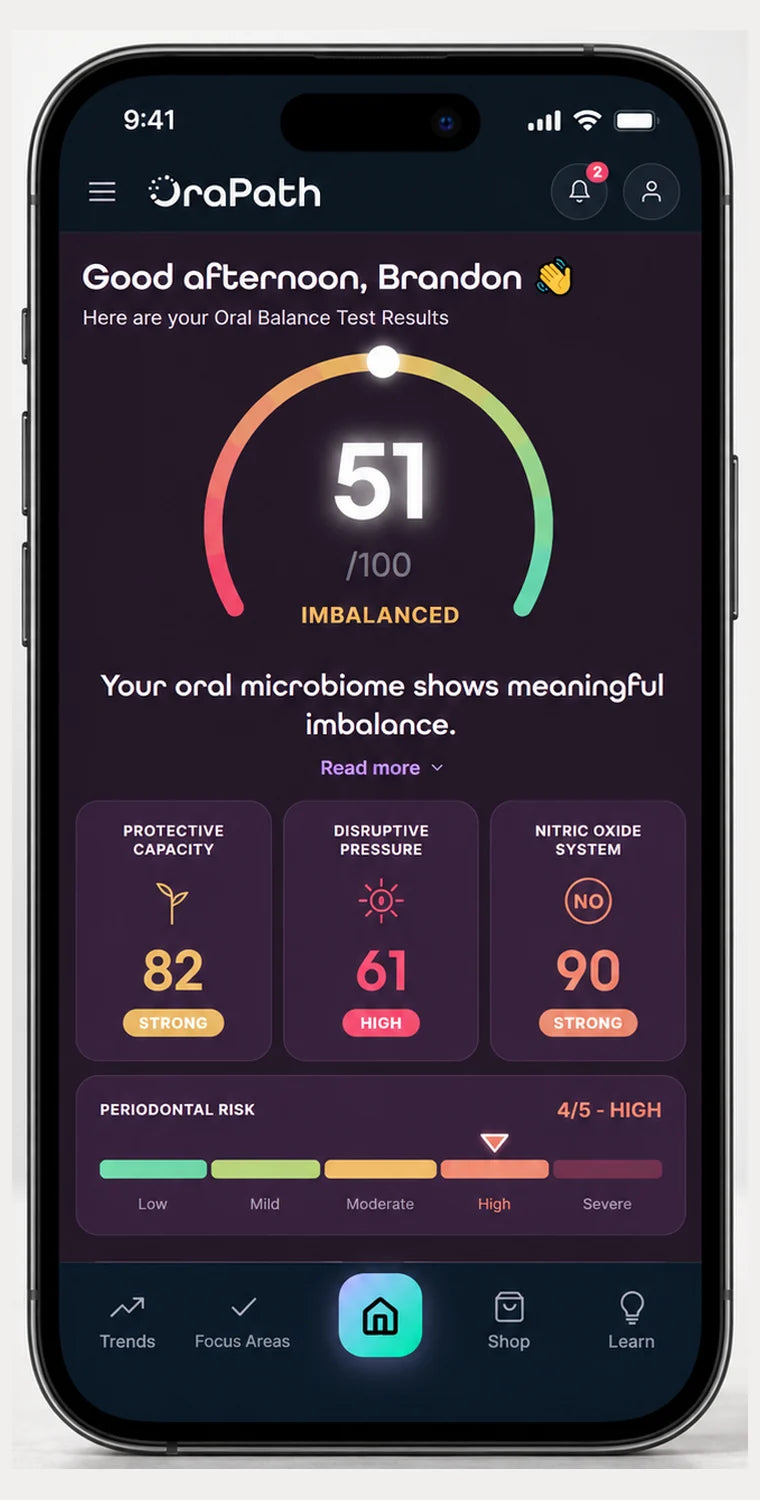
Your gum-disease risk level, 1 to 5 -
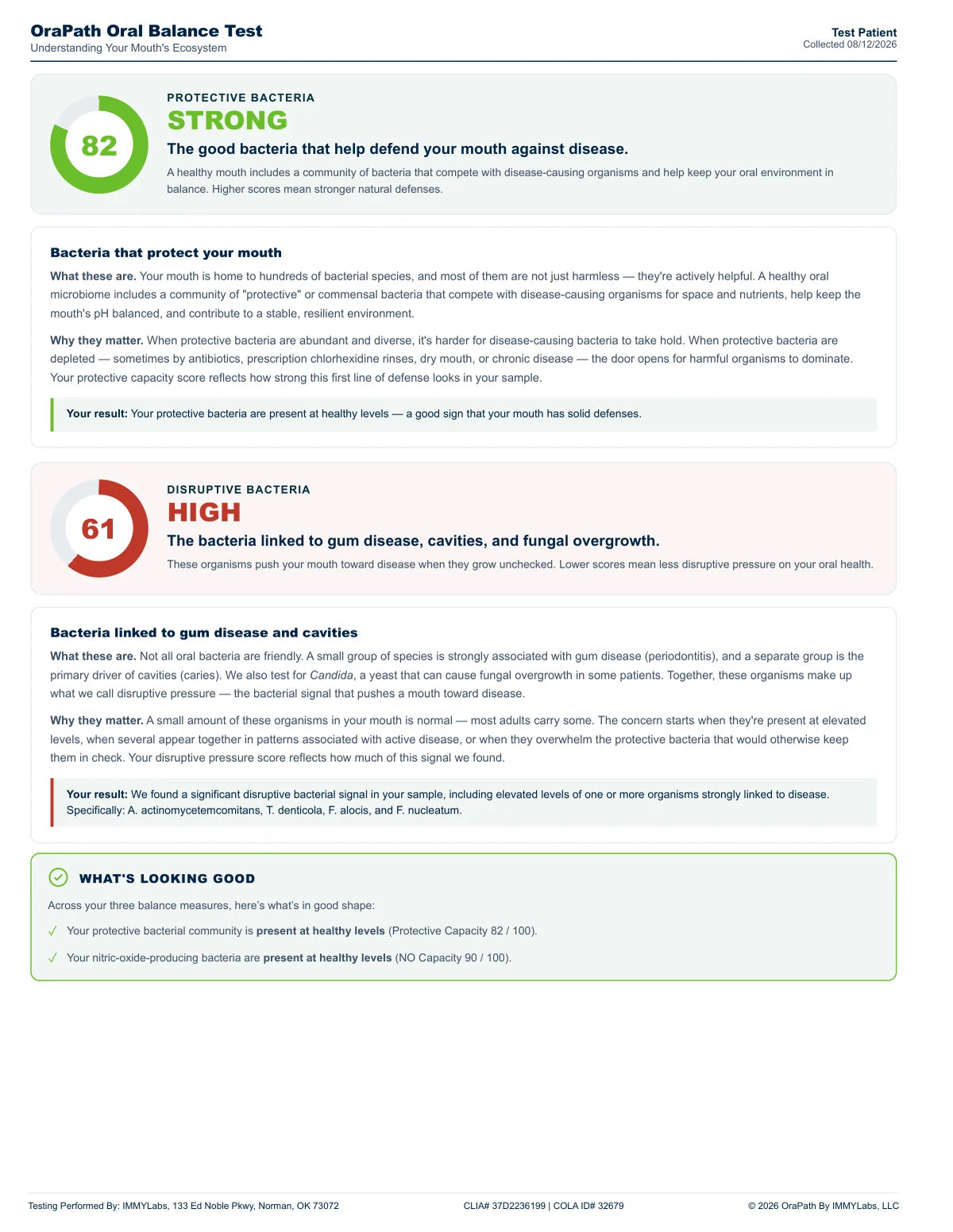
The good bacteria vs. the harmful ones, and which side is winning -
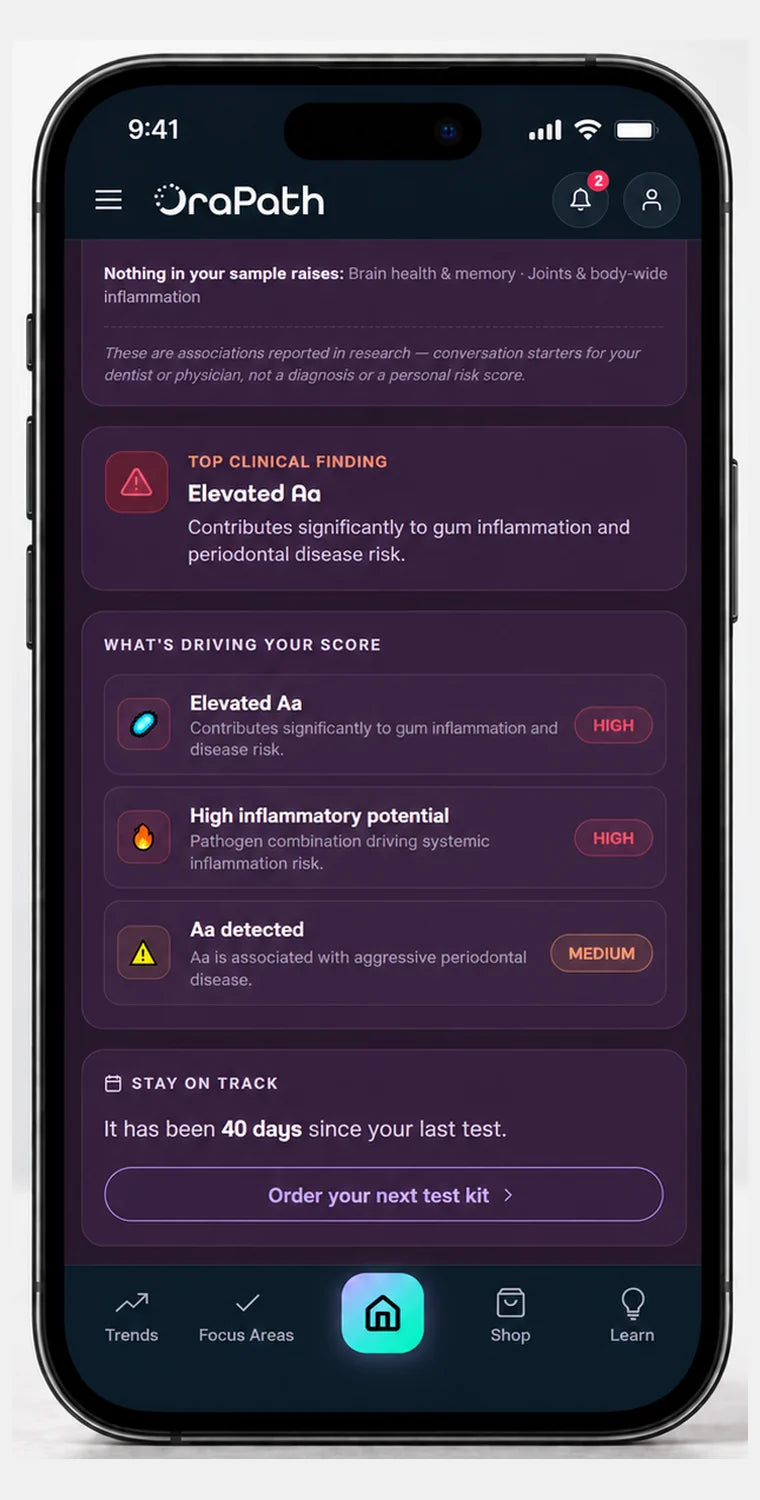
Your findings, ranked by what's driving yours
Your result, the moment it lands
Where do my results show up?
The dashboard opens on your Oral Balance Score — 51 out of 100 here, in the Imbalanced band — with the three sub-scores beneath it and the periodontal risk pattern along the bottom. This is the first thing you see when your sample is finished, and everything else on this page comes from the same measurements.
What to look at
- The score, and the band it falls in
- Protective capacity, disruptive pressure and the nitric-oxide system, each scored
- The periodontal risk pattern, 1 to 5
- Your report PDF, one tap away

The result, turned into a short list
So what am I meant to do about it?
Focus areas take what was measured and put it in order, so the result arrives as a handful of specific things rather than sixteen numbers. Each one names the finding it came from. They are prompts for the conversation with your dentist, who is the person who can decide what is appropriate for you after an examination.
What to look at
- Suggestions ordered by priority, not listed flat
- Each one shows the measurement behind it
- A prompt for your dental appointment, not a substitute for one

Associations, with their basis shown
Which of my own organisms relate to this?
Some organisms on this panel have been associated in published research with conditions elsewhere in the body. Every card names the organisms in your own sample that relate to it, so nothing appears without its basis, and the areas nothing in your sample raised are listed too. These are associations reported in research rather than a diagnosis or a personal risk score.
What to look at
- Every card names the organisms behind it
- Well-established and emerging research are labeled differently
- What your sample did not raise is stated as plainly as what it did
Why this score and not another
What pushed my number where it is?
This is the part a list of organisms cannot give you: the specific findings that moved this sample's score, each labeled with how much it contributed. It also tracks how long it has been since your last test, because one result describes a single day and the comparison is where the value builds.
What to look at
- The leading finding, stated first
- What contributed, and how strongly
- Days since your last sample
- Reordering, when you are ready to retest

Background, when you want it
Where do I go to actually understand this?
Every term on your report has something behind it if you want to go further — what the oral microbiome is, what periodontal pathogens do, why the nitrate-reducing bacteria are tied to circulation. It sits apart from your result, so the result stays readable and the depth is there when you want it.
What to look at
- Written for patients, not for clinicians
- Tied to the scores on your own report
- There when you want it, out of the way when you do not

All sixteen, grouped and tappable
Can I see everything, not just the summary?
The full panel, in five groups, with the category legend spelled out at the top. Each group opens. Whether a group is good high or good low is stated on the group itself, so a number never has to be interpreted without its direction.
What to look at
- The category is the result; the Detection Level is shown for completeness
- Five groups, each saying which direction is good
- Tap any group to open the organisms inside

Down to the individual organism
What does this one organism actually mean?
Open a group and each organism has its own entry: the full species name, its category, its Detection Level placed on a scale so you can see where it sits rather than reading a bare number, and a plain-language explanation of what that organism is associated with. This is the level of detail a printed page cannot reach.
What to look at
- Each Detection Level shown on a scale, not just as a figure
- The full species name alongside the short code
- What it is associated with, in plain language
- Association language throughout
The same result, as a report you can hand over
The app is where your result lives day to day. The PDF is the version you print or email — the same measurements, laid out for a dentist reading it in an appointment, with the reasoning written out rather than tucked behind a tap. Every page below is the same sample you just scrolled through.

Your scores, on one page
What did the test actually find?
The report opens with the same number the app leads with, on the same 0–100 scale, and the band it falls in. Underneath it sit the separate findings that score is built from — the nitric-oxide system, a gum-disease risk pattern of 4 out of 5, and a cavity finding — each with the organisms behind it shown alongside, so a dentist can see the basis without opening anything.
What to look at
- The score, and which of the five bands it sits in
- The six organisms behind the gum-disease pattern, with a category for each
- A cavity finding that came back low — reassurance is a result too
- The nitric-oxide pathway, explained step by step
What is working for you, not only against you
Is anything in my mouth already helping?
Most oral tests count only what is wrong. This page reports both sides: the protective organisms that compete with disease-associated bacteria, and the disruptive ones pushing the other way. In this sample the protective side came back strong even while the disruptive side ran high — two facts a single number would have blurred together.
What to look at
- Protective capacity, reported on its own terms
- Disruptive pressure, reported separately
- Why one can be strong while the other is high

The full panel, nothing held back
What exactly did you measure?
Every one of the sixteen targets appears here, grouped by what it does — gum-disease-linked, cavity-linked, fungal, protective, and the nitrate-reducing group. Each carries a plain category (Not Detected, Trace, Low, Moderate or High) and a Detection Level number, with a one-line note on what that organism does. The category is the result; the number is there for completeness.
What to look at
- Sixteen organisms, grouped by role
- A category first, a Detection Level second
- A plain-language note under every organism
- Which groups are good high, and which are good low

Associations beyond the mouth
Does any of this matter outside my mouth?
The same associations the app surfaces, laid out in full. The ones relevant to a particular sample appear in color and the rest are grayed out, as reassurance that nothing raised them. These are associations reported in research — not a diagnosis, not a personal risk score, and a starting point for a conversation with your dentist or physician.
What to look at
- Only the associations your own organisms relate to are highlighted
- Everything else is shown grayed, so nothing looks hidden
- Each one is labeled well-established or emerging research
- Stated as associations throughout, never as cause

What to do with it
How do I use this at my next appointment?
The last page turns the result into something you can act on: specific things worth raising based on what was found, a short list of questions to bring, a suggested retest window, and a glossary of every term used. It is the page most worth printing — your dentist is the person who can interpret any of it against an actual examination.
What to look at
- Findings worth raising, drawn from this sample
- Four questions to take to the appointment
- When to retest, and why
- A glossary, so no term goes unexplained
The Oral Balance Test is a laboratory-developed test performed by IMMYLabs (CLIA #37D2236199; COLA #32679), validated under CLIA, 42 U.S.C. § 263a. It has not been cleared or approved by the U.S. Food and Drug Administration. Results are semi-quantitative, describe a pooled saliva sample rather than any individual tooth or site, and are for adjunctive use — they support a dentist's examination rather than replace one, and nothing in the report or the app is a diagnosis.
You've seen the report. Now get your own.
One saliva sample, collected at home in about two minutes. Your own version of this report lands in your private OraPath account about a week later — and it's yours to take to your dentist.
Results in your private OraPath account · not a diagnosis — meant to be reviewed with your dentist alongside an exam.