
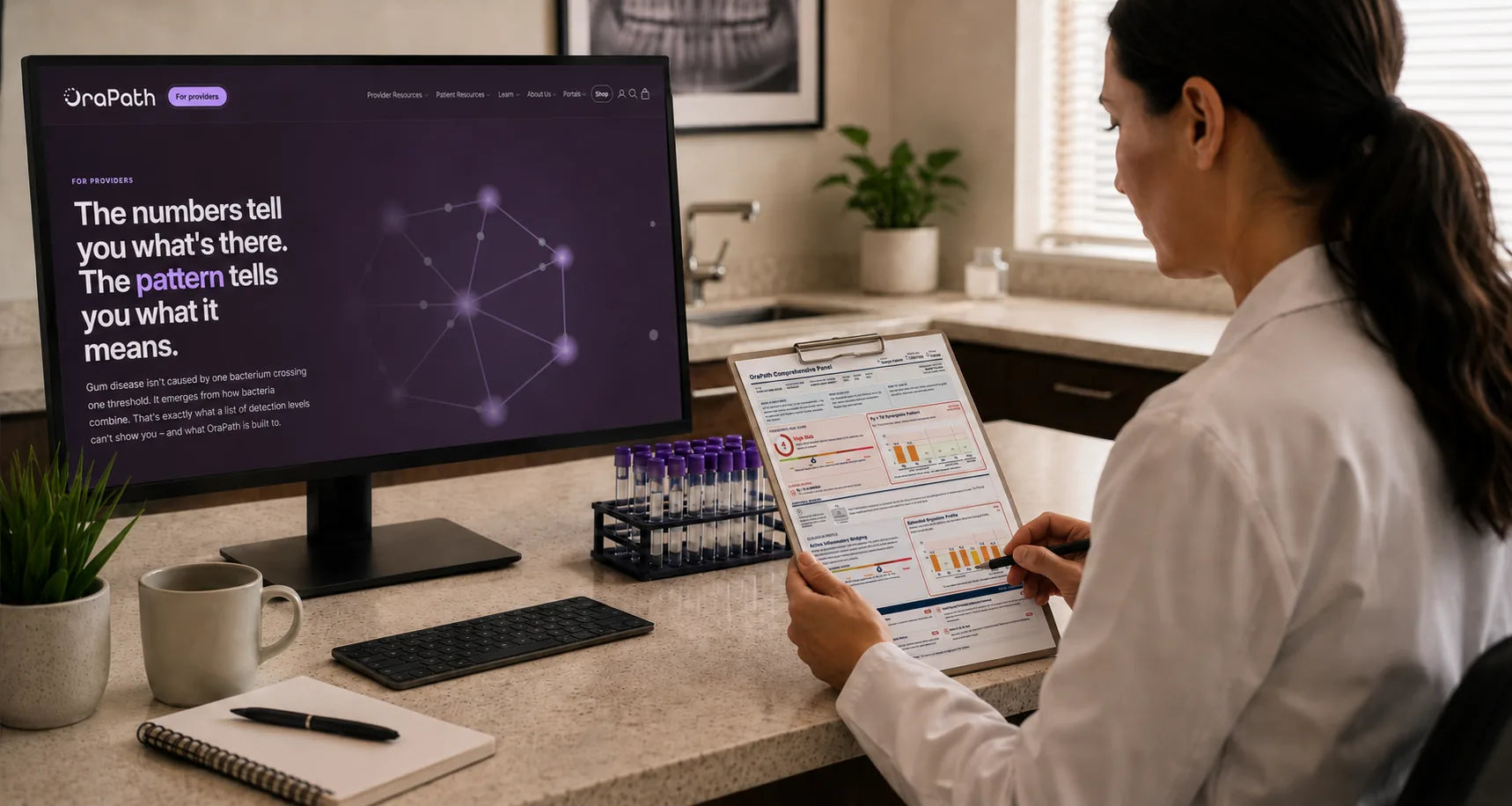
For practices already testing
You're already testing. You're still doing the interpreting.
If your practice already collects saliva, you've settled the hard question — that what's living in a patient's mouth is worth measuring. The part that usually isn't settled is what comes back, and how much of the thinking it does for you.
A pathogen list is a real result. It tells you which organisms are present and at what level. What it doesn't tell you is whether this patient's defenses are holding, how the findings sit together, or what changed since the last visit — and that's the part your team ends up reconstructing by hand, chairside, in front of the patient.
Provider pricing
One price per sample. Every report included.
What your practice pays for each panel. The provider and patient reports, plus antibiotic considerations where the profile calls for them, all come from that one sample at that one price.
- Kits are free
- You're charged only when you submit a sample
- Keep your current lab running while you compare
Scores, not just a list
One Oral Balance Score out of 100, then the subscores that produced it. The summary never hides which side moved, so the conversation starts at "here's what changed" instead of "here are your organisms."
Oral Balance Score · Disruptive Pressure · Protective Capacity
The protective side, measured
A healthy mouth isn't one without harmful bacteria — it's one with enough good ones. We score the protective community alongside the disruptive load, which is why two patients with the same pathogen levels don't get the same read.
Protective Capacity, scored per patient
Functional capacity, not just presence
We target the narG gene that performs nitrate conversion — so the score reflects what a patient's microbiome can actually do, rather than which species happen to be detectable. Most panels can't report a functional capacity at all.
Nitric Oxide System Score
Quantitative, so retests are readable
Every organism carries a Detection Level, and each step is about twice the bacterial load of the one below it. A follow-up at 60 or 90 days is a comparison rather than an interpretation — which is what makes the recall conversation concrete.
Detection Level, 0–30
A report family from one sample
The same collection returns a provider report for your chart, a patient-facing report written to be handed across the operatory, and antibiotic considerations where the profile warrants it. All three are below to download. You're not translating a lab document into patient language yourself.
Provider · Patient · Antibiotic Considerations
Claims that carry their evidence
Where a report mentions a systemic association, it says how strong the evidence actually is — well-established, supported, or emerging — and cites it. That's what makes it safe to hand to a patient, and defensible when they bring it to their physician.
Tiered and cited, on every association
OraPath tests are laboratory-developed tests performed by IMMYLabs (CLIA 37D2236199, COLA 32679). They are not FDA-cleared and do not diagnose any condition. Reports are clinical decision support, to be read alongside your examination and the patient's history.
What comes back
Read the actual reports.
One sample returns three documents — all three below are the same patient, from one collection. Download them, read them at your own pace, and compare them against what your current lab sends back.

Provider report
What lands in your chart. Scores with the penalties itemized, protective capacity against disruptive pressure, every organism at its Detection Level, and ranked clinical focus areas with a retest cadence.
Download PDF
Patient report
Written to be handed across the operatory. The same result in plain language, with systemic associations labeled by evidence strength and cited — so your hygienist isn't translating a lab document on the fly.
Download PDF
Antibiotic considerations
Where the profile warrants it. A regimen with alternatives — and a For Providers note stating plainly that microbial findings alone cannot drive that call and that these are not stand-alone prescribing algorithms.
Download PDFSample patient, synthetic data. Reports are clinical decision support and are not diagnostic of any condition.

Run it alongside what you use now.
The honest way to compare two labs is on the same patients. Tell us about your practice and we'll set you up with portal access and your first kits — then run them next to your current panel and read both reports side by side.
No switching cost to find out. Kits are free, collection is the same two minutes your team already does, and you're not charged until you submit a sample. Keep your current lab running as long as you like.
Or just ask
Talk to someone who reads these every day.
No pitch deck. Bring a report you already have and we'll walk through what an OraPath result would add to it.

Talk to Julie
Julie Cox, BSDH/RDH/EFDA · Provider Education
Best for clinical teams. Julie walks hygienists and dentists through reading the report, the chairside conversation, and what changes when you switch — in the language your clinical staff speaks.

Talk to Brandon
Brandon Neary · President
Best for the practice-level questions — how OraPath fits what you already run, the report family, pricing, and what moving your testing over actually involves.